
Why Adults Also Need Spaces to Imagine
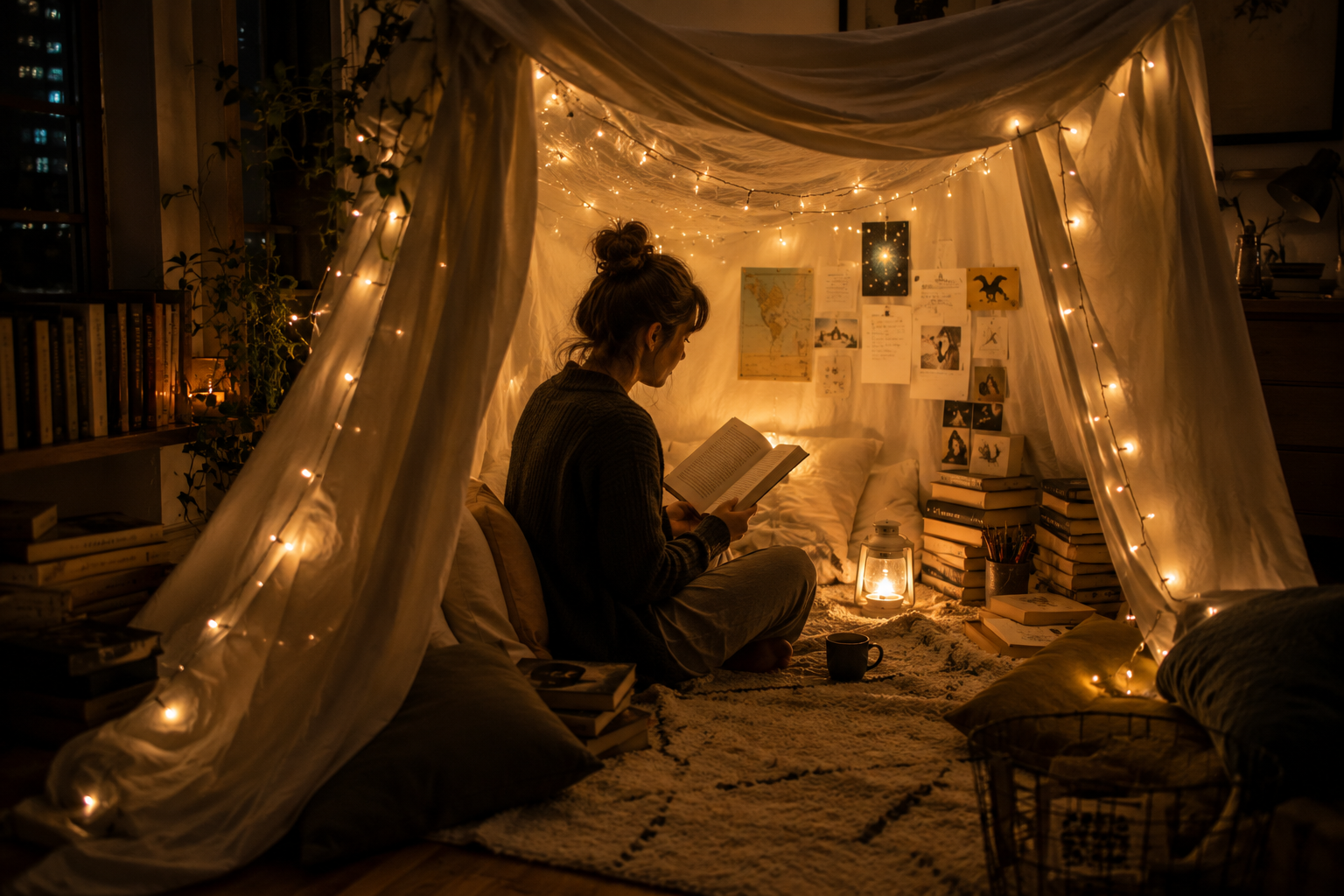
Lately, I’ve been thinking about something many adults seem to experience: after years of moving quickly between studies, work, responsibilities, and goals, we finally get a little free time… and still, something feels strange.
Rest doesn’t always arrive. Sometimes, emptiness does.
For those of us living in cities, it can be difficult to remember that life is not built only through productivity, deadlines, and turning every interest into something useful. Reading should teach us something. Drawing should become content. Creating should become profitable. Even rest seems to require justification…
A few weeks ago, my mom told me a story that stayed with me.
A man died on his way to work, right outside his house. What struck me most was knowing that, for years, he had talked about everything he would finally do once he retired.
“The trips. The rest. The free time. The things he truly wanted to explore”. As if play, curiosity, and enjoyment belonged only at the beginning or the end of life.
Between those two extremes, however, exists most of human life. Entire decades where many people live almost exclusively around productivity, responsibilities, and survival. As if learning how to sustain life had slowly replaced the experience of actually inhabiting it…
This is one of the reasons I’ve been thinking so much about libraries lately.
Not only as places to study, but as spaces where imagination is still allowed to exist. Quiet rooms where someone can get lost reading about astronomy, dragons, philosophy, gardens, maps, or any strange subject that awakens curiosity. Without pressure. Without evaluation. Without the need to immediately turn it into something profitable.
To understand why these spaces matter, I keep returning to two ideas: Donald Winnicott’s concept of potential space, and Stuart Brown’s research on play. One helps me think about imagination as a place between our inner world and the outside world. The other reminds me that play is deeply connected to vitality, adaptation, and well-being.
The psychoanalyst Donald Winnicott spoke about the idea of a “potential space”: an intermediate space between inner reality and external reality where play, imagination, creativity, and cultural experience can emerge.
It is the space where a child builds imaginary worlds, and also where adults create art, read, converse, explore ideas, and find meaning.
Perhaps part of our exhaustion appears when we lose access to those spaces.
Psychiatrist Stuart Brown has also explored how the prolonged absence of play can affect emotional vitality, creativity, and psychological well-being.
Through play, we explore, adapt, stay curious, and feel more connected to the experience of being alive.
Yet in the way many of us live now, play often disappears or becomes quickly transformed into performance.
Growing up should not mean abandoning imagination.
We also need spaces where we can read without assignments, talk without pressure, and explore ideas without turning them immediately into productivity.
Places where we do not need to prove anything.
Only remember that we still have an inner world.
Maybe some inner worlds do not need to be fixed or optimized.
Maybe they only need time, attention, and a place where they can open again.
If you also feel that your inner world needs more room to breathe, you can learn more about Imagination Club, a monthly gathering at BINAES where adults can read, talk, and explore their curiosity without pressure to turn it into productivity.
Discover Imagination Club here: https://beacons.ai/ascendiumdesign